

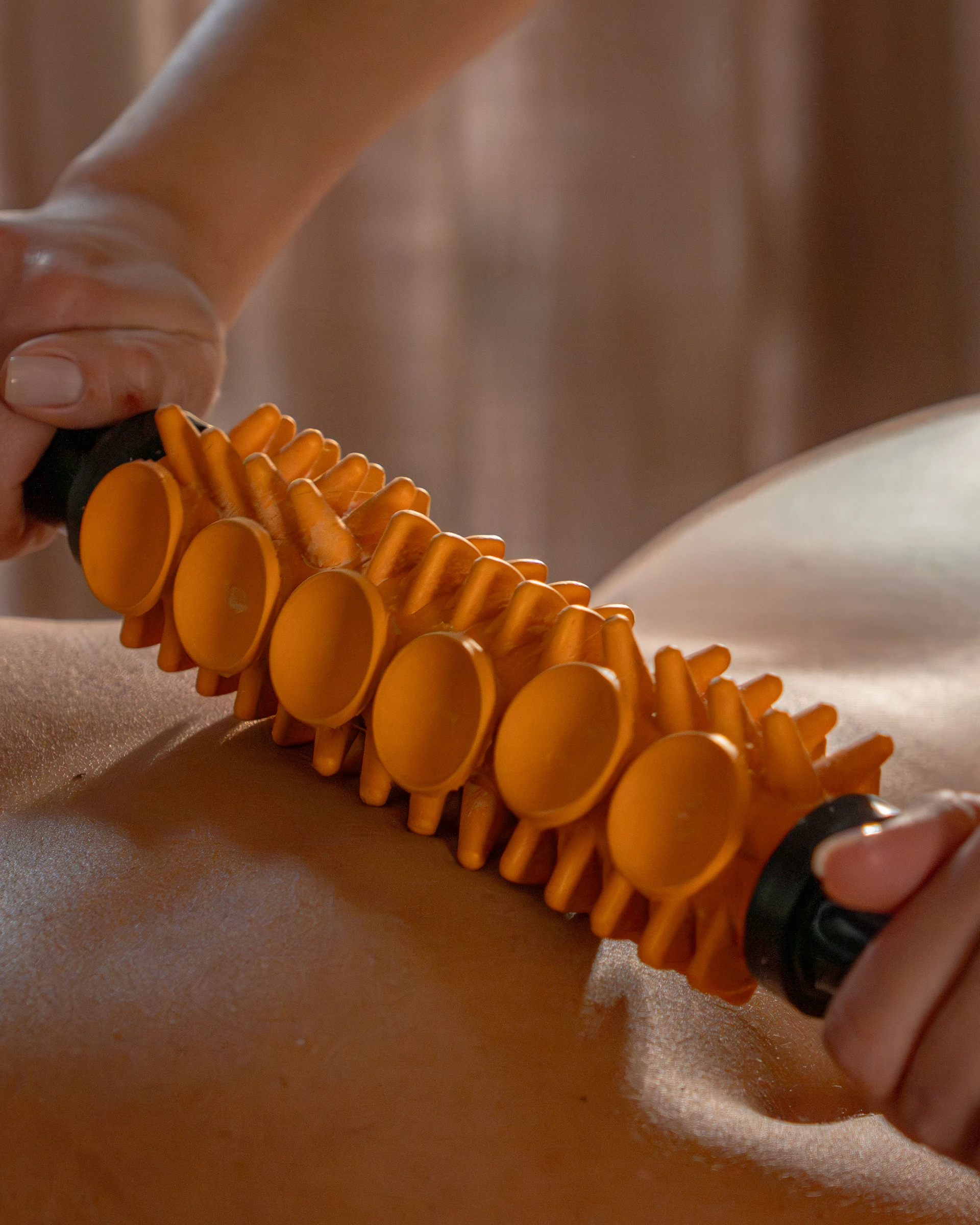
Searching for maderotherapy on the abdomen usually comes down to a practical question: what can a wooden roller actually do on this area, and how much of what you notice after a session is a lasting change versus a temporary shift in how the body looks or feels?
The abdomen changes throughout the day for many reasons. Posture, breathing, meals, digestion, menstrual cycle, fluid shifts and subcutaneous tissue can all affect appearance and sensation. A responsible session should therefore start by defining the goal rather than promising lost inches.
In short: abdominal maderotherapy uses wooden tools to vary pressure, contact area and direction over the skin and superficial soft tissue. It can be part of a body-contouring massage, but it is not a method for destroying fat, treating digestive causes of abdominal distension or guaranteeing permanent waist reduction.
The roller works on the surface; it does not “rearrange” the abdomen internally
In maderotherapy, the tool compresses and moves superficial tissue. Different roller shapes distribute pressure differently, which changes the feel and execution of the technique. That does not turn the tool into a technology that reaches internal organs or removes adipose tissue.
This matters especially around the abdomen because everyday terms such as “bloating,” “fluid retention” or “hard stomach” can describe very different things. Massage should not be used to diagnose their cause.
These are the structures directly exposed to pressure, friction and movement.
It may look or feel different after changes in posture, superficial tension and body sensation.
Pressure should be adjustable; maximum intensity is not a quality metric.
For the broader category, start with our guide to maderotherapy and wooden rollers.
An immediate visual difference is not the same as losing fat
After a session, some people describe the abdomen as lighter, less tense or visually different. Those perceptions can be real without turning them into a claim about fat loss.
Research on mechanical massage is not the same thing as research on manual wooden-roller maderotherapy. Devices such as Endermologie combine rollers and suction, and studies have reported mixed results. The American Academy of Dermatology notes that some studies found changes in cellulite while others did not, and that visible effects may be temporary. Those findings cannot automatically be transferred to a manual wooden roller.
“The work may temporarily change how superficial tissue feels and can be part of a body-contouring routine.”
“The roller breaks down fat, detoxes the abdomen or guarantees lost inches.”
If your main goal is body contouring, our maderotherapy service in Mexico City explains how the tool fits into a complete session rather than operating as a stand-alone treatment.
Mechanical massage has been studied, but that is not direct proof for “abdominal maderotherapy”
A study of 60 women compared mechanical massage, manual lymphatic drainage and connective tissue manipulation and reported changes in regional measurements. That does not prove a manual wooden roller produces the same result or that the changes represent permanent loss of adipose tissue.
Other Endermologie trials have produced mixed findings: some report changes in circumference or appearance, while randomized controlled work has found no significant differences. The useful takeaway is not to select the most convenient study, but to recognize that device, protocol, duration and measurement method matter.
References: American Academy of Dermatology; Kutluay et al.; Collis et al..
On the abdomen, more pressure does not automatically mean more benefit
The abdomen can feel more vulnerable than the back, legs or glutes. A well-structured session should start at a tolerable intensity and only increase if the person remains comfortable. Sharp pain, nausea, dizziness or an unusual sensation should not be framed as evidence that the treatment is “working.”
The U.S. National Center for Complementary and Integrative Health describes the overall risk of massage as low when performed appropriately, while noting rare reports of serious adverse effects, some associated with vigorous techniques or people at higher risk. In a sensitive area, that supports a simple rule: pressure adapts to the body; the body does not have to adapt to the tool.
- Intensity can be changed during the session.
- Extreme pain or bruising should not be a goal.
- Recent surgery, recent scars or new abdominal pain change the conversation before the area is worked.
- Persistent or concerning symptoms belong in a health evaluation, not a massage diagnosis.
General safety reference: NCCIH.
The tool changes the maneuver; it does not replace hands-on judgment
For the abdomen, the most useful comparison is not “roller versus hands” as if one were inherently better. Hands can respond immediately to sensitivity, tissue tension and tolerance. A roller can broaden or concentrate the contact area and make repeated movements feel different.
A good session therefore should not be designed around demonstrating how many tools are used. The important question is when a tool adds something useful and when manual work makes more sense.
At Savia, maderotherapy is treated as an extension of bodywork. To compare it with a broader contouring goal, see body contouring massage in Mexico City.
Four questions that matter more than a before-and-after photo
- How much of the session is hands-on and how much uses tools? This helps you understand whether there is a method or just a collection of rollers.
- Can pressure be adjusted? It should be, without being presented as “less effective.”
- What result do you consider realistic? Look for language about sensation, superficial tissue, comfort and process rather than guarantees about fat or inches.
- How do you decide whether to work the abdomen? Sensitivity, recent procedures and the person’s actual goal should matter.
“I want to work on my abdomen” can mean very different things
Someone may focus on the abdomen because they want an aesthetic contouring experience, because the area feels tense and they want more localized bodywork, or because they feel bloated and do not know why. Only the first two questions belong directly inside a wellness service.
If the concern is digestive, painful, sudden or persistent, massage has clear limits. That boundary does not reduce the value of the session; it prevents a wellness tool from being asked to solve a problem outside its scope.
Maderotherapy is a tool inside the Torrescano Method
At Savia, Masajes Reductivos de las Torrescano, bodywork is built around a family technique whose canonical origin dates to 1958. Sessions combine hands-on work with tools or extensions when they have a specific function, always adapting area and intensity to the person.
If your priority is abdomen, waist or body contouring, see how we work on our maderotherapy page. For the wider session experience, explore massage benefits and ways to experience Savia.