

Body-contouring massage and liposuction are often placed in the same sentence because both are marketed around shape, waistlines, thighs, arms, or localized areas. That does not make them comparable treatments.
Liposuction is surgery that removes subcutaneous fat. Body-contouring massage is non-invasive bodywork that applies pressure and movement to skin and soft tissue. One does not become a substitute for the other simply because a marketing page uses phrases such as “non-surgical sculpting.”
The useful decision starts with the mechanism. Once that is clear, questions about recovery, risk, cellulite, cost, and expected change become much easier to interpret.
Choose by goal, not by intensity. If your goal is non-invasive wellness, a body-care ritual, superficial tissue work, or a modest appearance-focused experience, massage may fit. If your goal is actual removal of localized fat, liposuction is a surgical category and belongs in a consultation with a qualified plastic surgeon. Massage cannot reproduce that mechanism.
These are different interventions, not two strengths of the same one
Massage does not remove adipose tissue
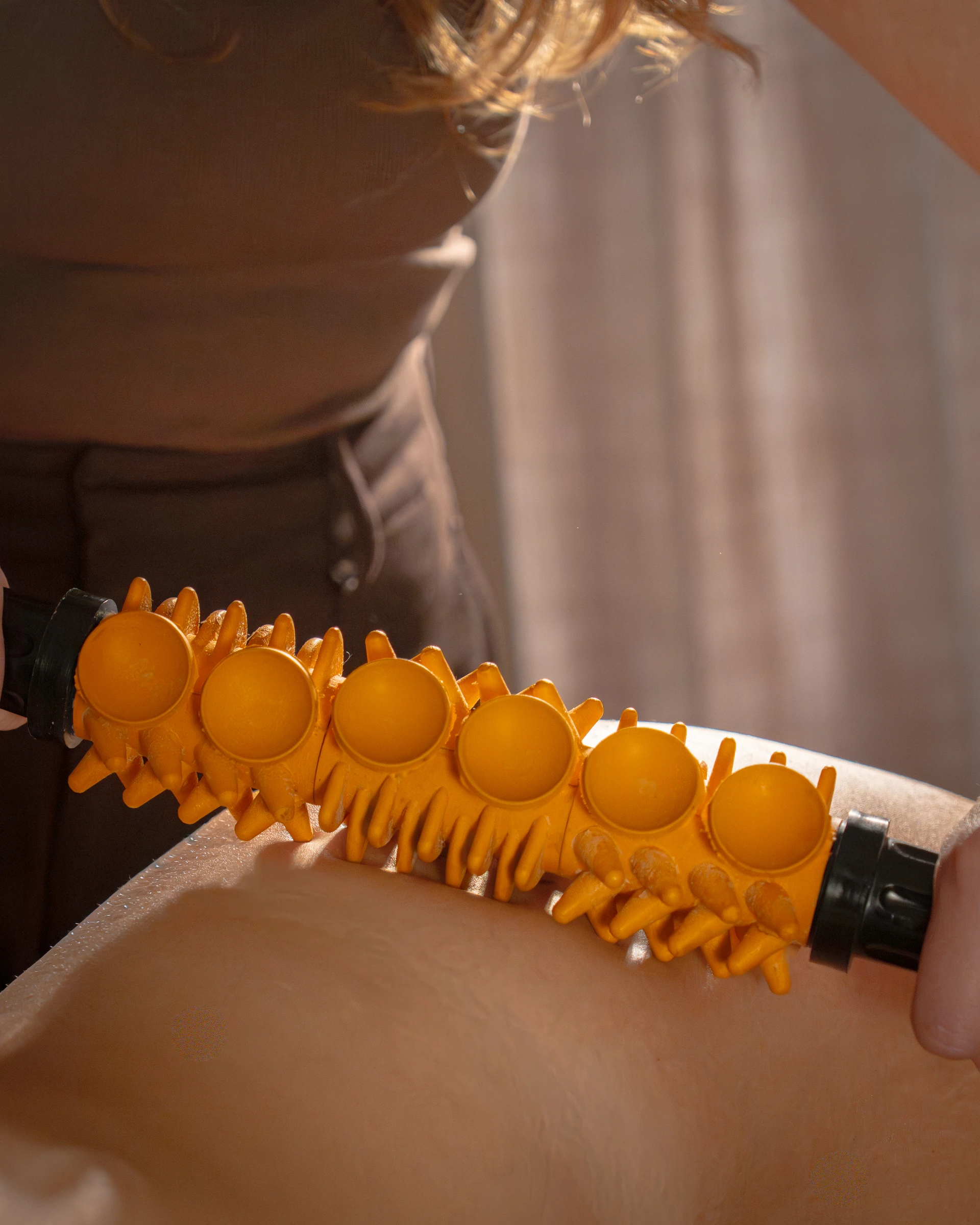
Manual body-contouring massage can use hands, rollers, or other tools to change how mechanical pressure is distributed across superficial tissue. It may support relaxation, perceived lightness, comfort, tissue mobility, and appearance-focused goals.
What it does not do is suction fat cells out of the body. Liposuction, by contrast, is specifically designed to remove localized fat deposits from selected areas. The American Society of Plastic Surgeons describes liposuction as a surgical procedure for removing excess fat from areas such as the abdomen, waist, thighs, hips, arms, back, and other regions.
“I want to look more defined” can hide two very different expectations
A massage-level goal
You want a non-invasive body-care experience, adjustable pressure, focus on a particular area, a sense of lightness, relaxation, or a modest change in how superficial tissue feels or looks.
A surgery-level goal
You want actual reduction of a localized fat deposit and are willing to consider medical screening, anesthesia, surgical risk, recovery, and the limits of what liposuction can change.
If the only result that would satisfy you is true removal of fat tissue, repeatedly buying a massage package is not a logical substitute for discussing surgical options. Conversely, if you do not want surgery, framing a massage as “almost liposuction” creates expectations that the technique cannot support.
“Non-surgical liposuction” is not a neutral phrase
The phrase suggests that a non-invasive service can deliver the defining mechanism of liposuction without surgery. Manual massage cannot do that.
Some non-invasive medical devices are designed to reduce fat through specific energy-based mechanisms. Those technologies have their own evidence, device settings, indications, and risks. A hand technique or wooden roller should not inherit those claims simply because all of them are marketed under “body sculpting.”
If a provider claims to “melt fat,” “break adipocytes,” or “remove localized fat” with manual pressure, ask for direct evidence for that exact technique and protocol.
The difference in downtime reflects the difference in intervention
After massage
Most people can return to ordinary activity. Some may feel temporary tenderness, especially after firm work. Significant bruising or severe pain should not be treated as a required sign of effectiveness.
After liposuction
Recovery can involve swelling, compression garments, wound care, medications, activity restrictions, and medical follow-up. Exact instructions depend on the procedure and surgeon.
The contrast is important: lower downtime does not mean massage is “the same result with less recovery.” It means the intervention is less invasive because it is doing something fundamentally different.
Liposuction should be evaluated as surgery, not as a beauty add-on
The American Society of Plastic Surgeons lists potential risks including anesthesia complications, infection, fluid accumulation, changes in sensation, contour irregularities, poor wound healing, deep vein thrombosis, cardiac or pulmonary complications, and injury to deeper structures.
That does not mean liposuction is inherently a bad choice. It means the decision belongs inside a proper medical consultation where benefits, suitability, alternatives, and risks can be weighed.
Source: American Society of Plastic Surgeons — Liposuction risks and safety.
Neither option should be sold as a substitute for overall weight management
The American Society of Plastic Surgeons states that liposuction is not a treatment for obesity or a substitute for diet and exercise. That distinction is even more important for massage, which does not remove fat at all.
Body weight and body contour overlap, but they are not identical goals. A person can seek a body-care experience without pursuing weight loss, and a person considering liposuction should still understand that the procedure is intended for localized fat—not general weight reduction.
Fat and cellulite are not the same target
Cellulite involves the relationship among skin, connective tissue bands, and underlying fat. The American Academy of Dermatology notes that cellulite is extremely common and that different treatments have different levels of evidence and durability.
Liposuction is not designed to correct the fibrous architecture that creates dimpling and can sometimes make cellulite more apparent. Massage may be used as an appearance-focused routine, but it should not promise permanent elimination either.
Massage after liposuction is a separate clinical decision
Some surgeons include forms of physical therapy, gentle lymphatic work, or other postoperative care in recovery plans. That does not mean every spa massage is appropriate after surgery.
Timing, pressure, treated areas, wound status, compression garments, medications, and the surgeon’s instructions all matter. A person who has recently had liposuction should not book deep, aggressive bodywork simply because a service is marketed as “post-op drainage.”
If the reason for massage is recent surgery, the operative team’s guidance takes priority over a general wellness protocol.
Five questions clarify the category quickly
- Do I want actual removal of localized fat, or a non-invasive body-care experience?
- Am I willing to accept surgical recovery and medical risk for a surgical result?
- Is cellulite my main concern rather than fat volume?
- Am I choosing based on a realistic mechanism or on dramatic marketing language?
- If I recently had surgery, has my surgeon cleared the type and timing of massage I am considering?
A service does not need to imitate surgery to have value
One reason the comparison becomes distorted is that massage is often marketed as worthwhile only if it can promise centimeters, fat reduction, or a surgical-style transformation.
That sets the wrong standard. A well-designed manual bodywork session can be valuable because it is non-invasive, adaptable, tactile, repeatable, and focused on comfort, superficial tissue, and body awareness. Those are different benefits from surgery, not failed versions of surgery.
The strongest body-contouring massage claim is not “we do what liposuction does without surgery.” It is “we know exactly what manual bodywork can do, what it cannot do, and how to adapt it responsibly.”
Savia belongs clearly on the non-invasive side of this comparison
Savia, Masajes Reductivos de las Torrescano works from the Torrescano Method, a family bodywork technique whose origins date to 1958. Sessions today are performed by physiotherapists trained in the method.
The Torrescano Massage combines manual work and rollers with adjustable pressure and priority areas. It is positioned as wellness and body aesthetics—not as surgery, non-surgical liposuction, a weight-loss treatment, or a medical fat-removal procedure.
For the broader context, read our body contouring guide for Mexico City, explore our services, or see our Roma Norte location.