

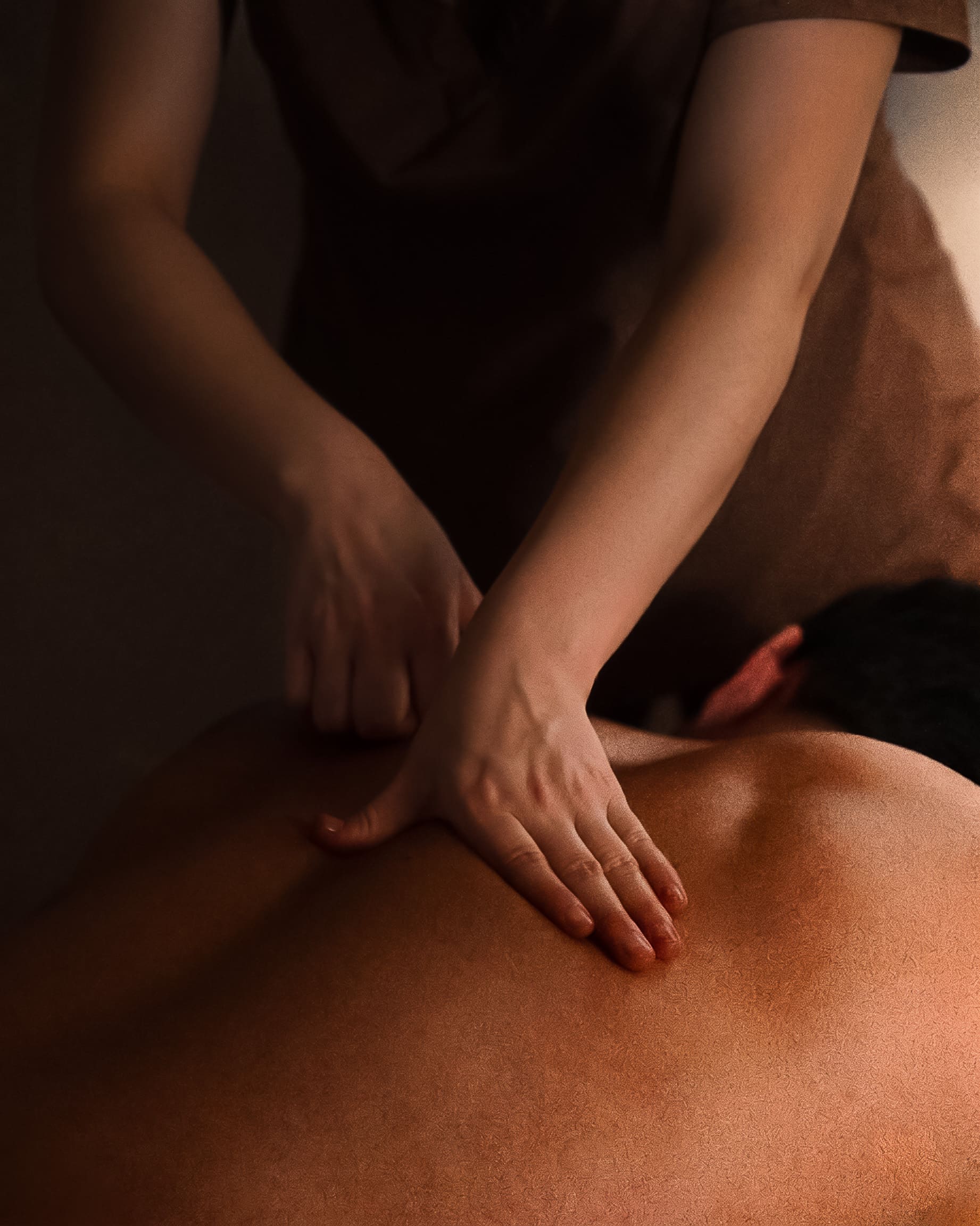
Searching for body contouring in Mexico City can lead to services that share a name while belonging to very different categories. A studio may mean firm manual massage, wooden rollers, lymphatic-style work, vacuum or energy-based devices, or a package that combines several techniques.
That makes the label itself a weak buying signal. The useful first question is: what physically happens during the session, and what kind of result is the provider claiming that mechanism can produce?
For English-speaking residents and visitors, the terminology can be even harder to decode because Mexican terms such as masaje reductivo do not map neatly to one standardized service in the U.S., Canada, or Europe.
Manual body contouring is bodywork, not fat-removal treatment. It can be part of a wellness or appearance-focused routine and may change how superficial tissue feels or looks temporarily, but it should not be sold as weight loss, permanent localized fat removal, “detox,” or non-surgical liposuction. Choose by mechanism, pressure control, realistic expectations, safety boundaries, and the quality of the provider’s process.
Four terms that can mean different things across Mexico City
Usually a firmer manual massage focused on areas such as the abdomen, waist, legs, arms, or back. It is a commercial category, not one standardized protocol.
Tool-assisted massage using shaped wooden rollers or other implements. The tool changes contact and pressure distribution; it does not prove fat destruction.
Literally lymphatic drainage. Clinical manual lymphatic drainage is a specialized gentle technique; spa services may use the term more broadly for wellness.
Can refer to manual massage, devices, or medical aesthetics. Ask exactly which technology or technique is included before comparing outcomes.
The same marketing phrase can hide completely different interventions
A manual body-contouring session may use hands, rollers, repeated strokes, localized pressure, and extra time on selected areas. Another provider may add suction, heat, radiofrequency, ultrasound, cryolipolysis, or other devices. Those are not interchangeable merely because the website calls all of them “sculpting.”
Ask the provider to describe the session in ordinary language: which areas are treated, whether tools or devices are used, how pressure is controlled, how much hands-on time is included, and what the provider believes each component is intended to do.
“We use hands and rollers, adapt pressure by area, and focus on the feel and appearance of superficial tissue within a wellness routine.”
“We melt localized fat, remove toxins, and guarantee a number of centimeters in one session.”
Four goals that should not be routed to the same service
Manual body contouring may fit if the pressure, areas, experience, and expectations are clear.
Use appearance and comfort as the decision criteria, not promises of permanent elimination. See our cellulite and postpartum guide.
First determine whether the pattern belongs in wellness at all. Our swelling guide separates familiar heaviness from warning signs.
Manual massage is the wrong mechanism. Our massage vs. liposuction comparison explains the category difference.
A visual difference after a session is not automatically a tissue-loss result
The appearance of a body area depends on skin, connective tissue, subcutaneous fat, muscle, posture, lighting, digestion, and temporary fluid distribution. Massage applies mechanical force externally to skin and soft tissue. It does not surgically remove adipose tissue.
Some people notice relaxation, warmth, a sense of lightness, a change in how the superficial tissue feels, or an appearance they prefer after the session. Those experiences can be meaningful without being converted into a claim of permanent fat loss.
A better way to describe a result
“My waist feels less tense and I like how the area looks after repeated sessions” is a valid personal observation. “The massage destroyed abdominal fat” is a biological claim that requires a different level of evidence.
Use images as documentation, not proof of mechanism
Posture, camera distance, lens choice, lighting, breathing, muscle contraction, hydration, clothing compression, and time of day can change a photograph quickly. That makes dramatic before-and-after images weak evidence when the conditions are not standardized.
If you want to track appearance, use the same location, light, camera height, distance, posture, and approximate time of day. Compare several checkpoints rather than one pair of photos taken minutes apart.
What a manual body-contouring provider can say responsibly
Targeted bodywork, comfort, perceived lightness, superficial tissue feel, an active massage experience, and appearance-focused goals with variable results.
Guaranteed weight loss, permanent localized fat removal, toxin extraction, identical centimeter loss, permanent cellulite elimination, or a “non-surgical liposuction” effect from manual pressure.
Cellulite is not the same thing as excess body fat
The American Academy of Dermatology explains that cellulite is extremely common, including in people who are thin or physically fit. Its appearance is related to the interaction among skin, connective tissue bands, and underlying fat.
Different cellulite treatments have different mechanisms and levels of evidence. A manual massage cannot borrow proof from a device or medical procedure simply because both are marketed under “body contouring.” For manual massage, a realistic conversation stays focused on appearance, texture, comfort, and whether the experience is worth repeating.
Firm bodywork should still be adjustable
Body-contouring massage can feel more active than a relaxation massage, but pain is not a dose and bruising is not a quality metric. Sensitivity differs by body area and from one visit to the next.
The National Center for Complementary and Integrative Health describes massage as generally low risk when performed appropriately while noting rare serious adverse events, some associated with vigorous techniques or higher-risk clients.
A coherent method should be able to reduce pressure, change a tool, alter direction, spend less time on an area, or skip it without pretending the whole session has become ineffective.
Four moments should make sense before you decide whether to repeat it
Before
Your goal, priority areas, sensitivities, recent procedures or injuries, and preferred pressure are discussed.
Start
The practitioner calibrates intensity instead of beginning with the strongest technique available.
During
Pressure and time by area can change. Tools serve a purpose inside the method rather than being treated as magical objects.
Close
The provider reviews how the session felt and discusses options without diagnosing a problem or manufacturing urgency.
Stronger pressure does not mean stronger drainage
Clinical manual lymphatic drainage uses deliberately gentle, directional techniques in specific contexts. Body-contouring massage is generally firmer and more localized. One should not be sold as an “intense” version of the other.
If swelling is the main reason you are booking, first understand the pattern and whether it belongs in routine wellness. Our lymphatic drainage guide for Mexico City explains the difference between a spa context, clinical MLD, postoperative care, and unexplained swelling.
A package size is a commercial structure, not a universal biological dose
There is no evidence-based number of manual body-contouring massage sessions that applies to every studio, technique, body, and goal. A provider can recommend a rhythm, but it should be able to explain the reasoning and allow the plan to change with your response.
A practical sequence is to define the goal, use early sessions to understand the method, review whether the benefit is meaningful, and then decide whether to continue, space visits out, change the focus, or stop. Our session-planning guide gives a structured framework.
Not every body concern belongs in a wellness studio
Recent surgery, acute injury, unexplained severe pain, significant vascular disease, a history of thrombosis, active skin infection, fever, sudden unexplained swelling, or other relevant medical issues can change whether firm bodywork is appropriate.
A provider that can say “this is outside our scope” is demonstrating judgment. If a concern needs diagnosis or medical treatment, massage should not be used to delay appropriate care.
Add logistics to the quality checklist
Roma Norte, Condesa, Juárez, and Polanco can look close on a map while traffic changes practical travel time significantly.
If English-speaking reception or a therapist who can communicate comfortably in English matters, verify it before arrival.
Ask about taxes, deposits, required add-ons, gratuity, cancellation terms, and whether the advertised duration equals treatment time.
Interior numbers, building access, and written directions can matter in dense neighborhoods.
Eight questions reveal more than polished branding
- What does “body contouring” mean at this studio?
- What actually happens during the session: hands, rollers, devices, heat, suction, or something else?
- Who performs it and how are practitioners trained in the method?
- Can pressure and priority areas be adjusted in real time?
- What should I realistically expect after one session and after several?
- What symptoms or conditions would make the studio postpone or decline the service?
- How much actual treatment time is included?
- What is the total price, and what changes if I buy a package or add-on?
If you already have a shortlist, use our seven questions to ask before booking to compare the finalists.
Choose the method, not the fantasy built around the method
Manual body contouring can be valuable when the goal is clear, the experience is well delivered, and the claims remain proportional to what massage can actually do.
A strong provider should be able to explain what it does, what it does not do, how it adapts, how you can judge whether it is worth repeating, and when it should not be done.
How body contouring fits the Torrescano Method
Savia, Masajes Reductivos de las Torrescano works from the Torrescano Method, a family bodywork technique whose origins date to 1958. Sessions today are performed by physiotherapists trained in the method.
The Torrescano Massage is the base experience and combines manual work and rollers, with pressure and priority areas adapted to the person. Extensions can orient the session toward different wellness goals without turning each goal into a disconnected treatment.
Savia positions this work within wellness and body aesthetics. It is not presented as medical treatment, weight-loss therapy, guaranteed fat removal, or non-surgical liposuction.
Explore our services or visit our Roma Norte location to understand the current experience before booking.